
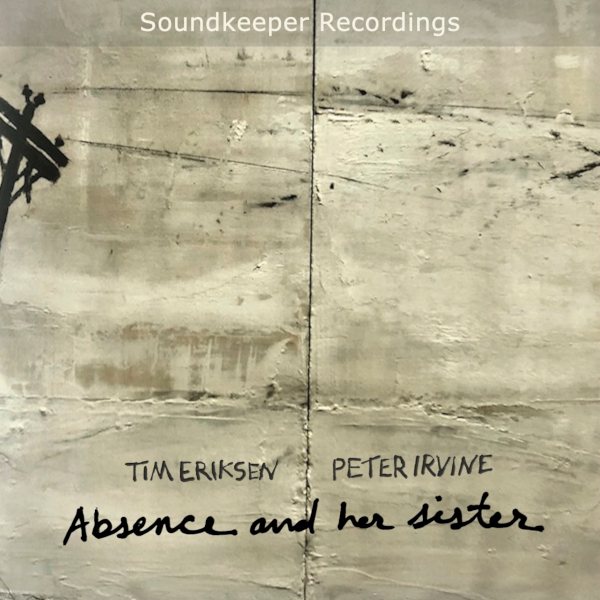
Traditional New England ballads and original compositions, reimagined with a minimalist touch.
| Jolly Tinker | |
| Every Sound Below | |
| Song of the Lost Hunter | |
| A Tiny Crown | |
| Two Sisters | |
| As She Sank She Rose Again | |
| The Fitchburg Tragedy | |
| Amelia | |
| I Wish the Wars Were All Over | |
| Boston | |
| Aber Dojde Donke |
A warm-up take of "Jolly Tinker"
(Sound for this video via camera mic)
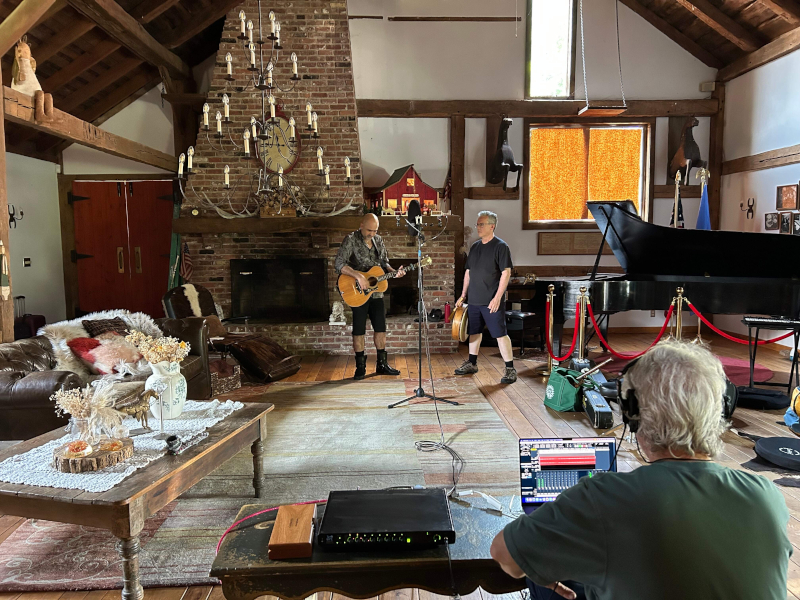
Tim and Peter record "Jolly Tinker"
"Every Sound Below"
(Sound for this video via camera mic)
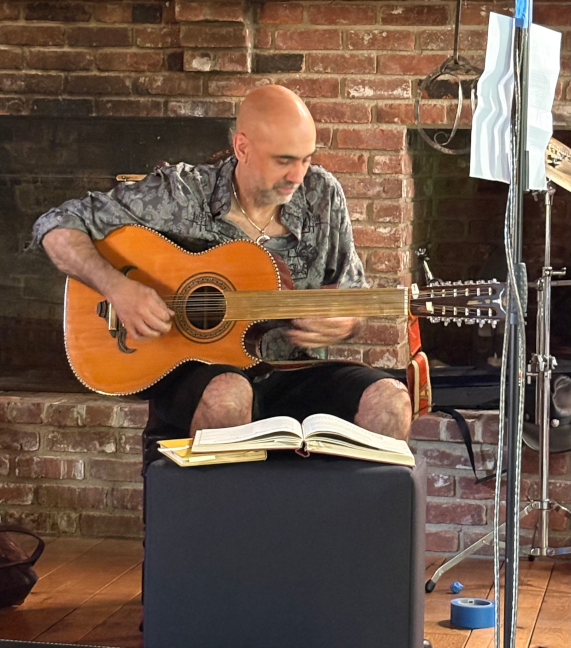
Tim warms up "Song of the Lost Hunter"
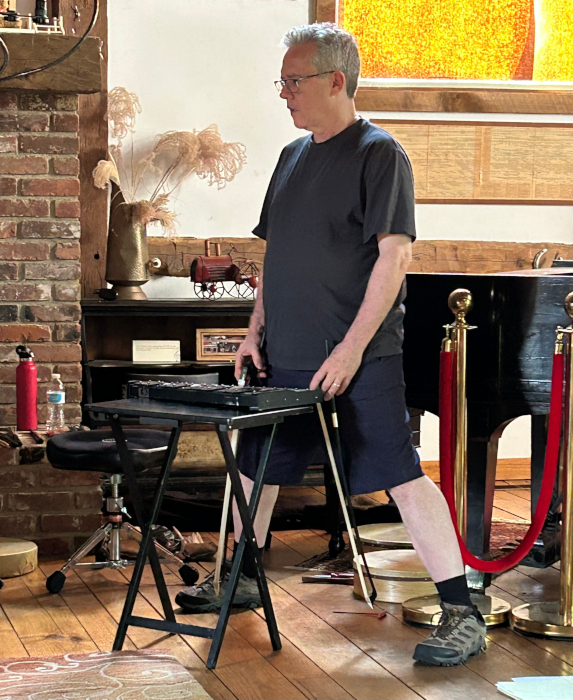
Peter plays "Song of the Lost Hunter"
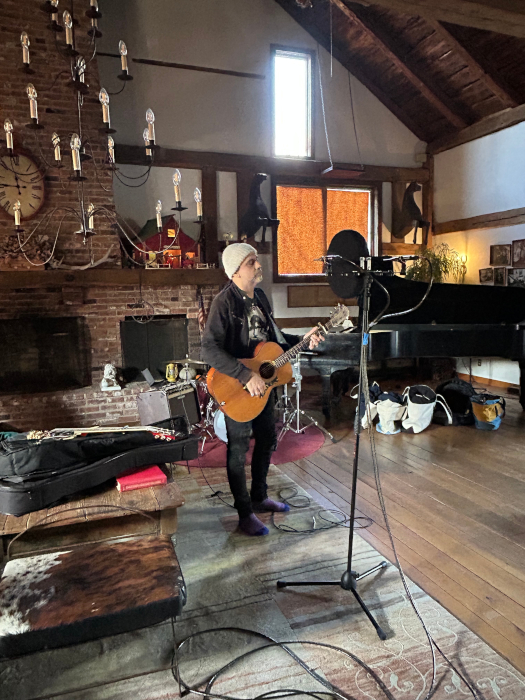
Tim warms up "Two Sisters"
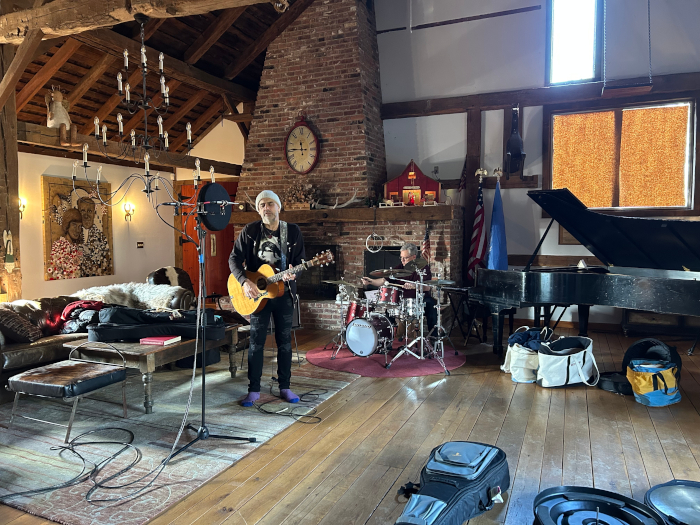
Tim and Peter run through "Two Sisters"
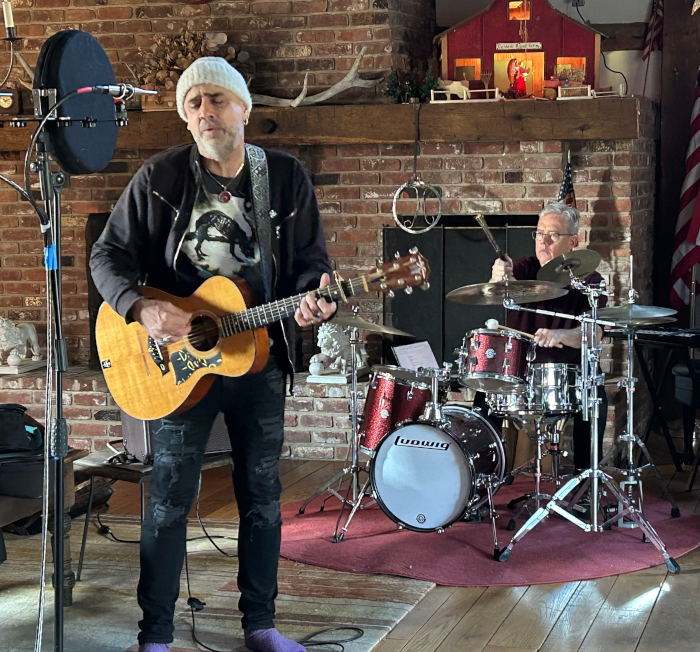
Tim and Peter run through "Two Sisters"
"Two Sisters"
(Sound for this video via camera mic)
"A Tiny Crown"
(Sound for this video via camera mic)
"As She Sank She Rose Again"
(Sound for this video via camera mic)
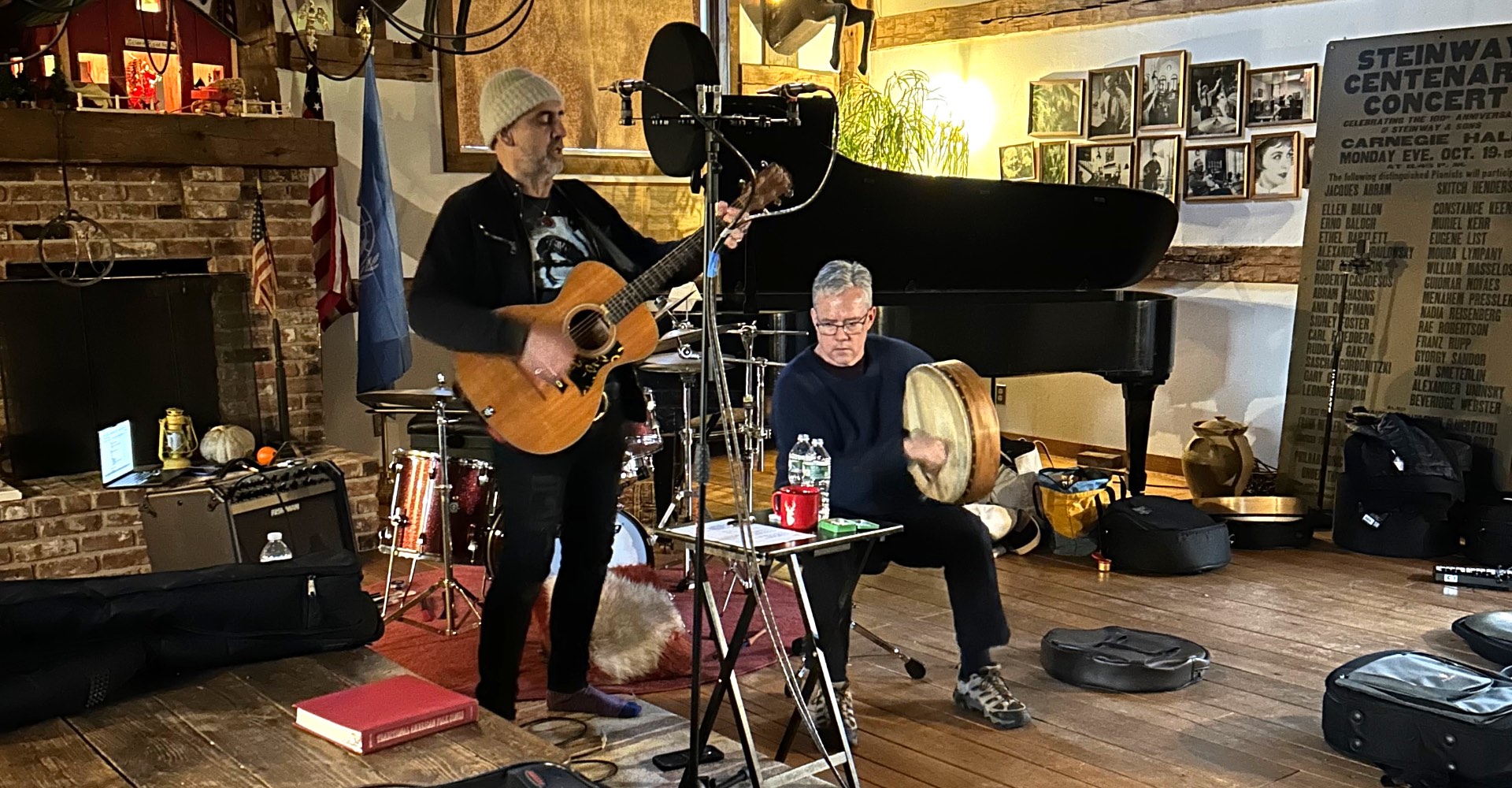
Tim and Peter play "Boston"
"I Wish the Wars Were All Over"
(Sound for this video via camera mic)
"Aber Dojde Donke"
(Sound for this video via camera mic)
With Absence and her sister Tim Eriksen and Peter Irvine return to their roots in folk minimalism and Gothic Americana- new and ancient songs of their native New England informed by the wide palette of their other collaborations. The two are probably best known for their musical contributions to films including the Oscar-winning Cold Mountain and cult horror phenomenon The Outwaters, and as founding members of the anomalous folk-noise outfit Cordelia’s Dad, "the only band to have performed with both Doc Watson and Nirvana." But while echoes of punk-folk and shapenote music abound on Absence and her sister, so does the dissonance and rhythmic complexity of their Bosnian band Žabe I Babe, the deep groove they picked up from collaborators like banjo master Dwight Diller and East African gospel singers the Naamaara sisters, and the love of experimentation and power of repetition celebrated in Terry Riley’s In C, the first piece the two ever played together as teenagers. The album also abounds with echoes from Pumpkintown, the duo's New England magic lantern show with painter/projectionist Susan Brearey, named for the birthplace of both Absence Wing and her twin. The place may be semi-fictional, but the musicians know its sunlit meadows and dark secrets well.
Absence and her sister highlights Eriksen and Irvine's imagination, minimalist restraint, and the preternatural mind-meld of longtime collaborators with a history of coloring outside the lines. With decades of South Indian veena under his belt, Eriksen knows his way around a fretboard. But with the exception of the quietly virtuosic guitar work on "Amelia," and the oud-like improvisation on his bespoke fretless bajo sexto in "Song of the Lost Hunter," here Eriksen favors the haunting insistence of two alternating chords ("Jolly Tinker," "Two Sisters," "Fitchburg Tragedy") or even two alternating notes ("Every Sound Below"). In the epic tale of ghostly vengeance "As She Sank She Rose Again," he forgoes instrumentation altogether, showcasing the unaccompanied solo balladry for which he is celebrated. (Iconic balladeer and folklorist Jean Ritchie even chose him as the only-ever recipient of the Jean Ritchie Musical Heritage Award). Irvine's accompanying percussion is also suitably sparse throughout, though not lacking in its own moments of understated virtuosity ("Boston," "I Wish The Wars Were All Over") and the cinematic colors of bowed and struck metallophones that hint at his background in orchestra and theater.
The stories are both strange and strangely familiar. "A Tiny Crown" is a kind of watery dream about a childhood inhabited by Sea Monkeys, while "Every Sound Below" explores a moonlit field, wondering if the silver orb is a sister or just another rock, and resting with fireflies in the ephemeral glow of earth and moon and sound itself. Other songs tell of loneliness so desperate it leads one woman to murder, and worse, ("Song of the Lost Hunter"), the tragic loss of four young cousins in the town of Eriksen’s birth ("The Fitchburg Tragedy"), an instrument, made of a sister’s bones, that can play only a single tune ("Two Sisters"), a young woman who turns to soldiering to find her lost love ("I Wish The Wars Were All Over"), and cannibalism narrowly averted ("Boston"). The album ends with the old Macedonian song "Aber Dojde Donke," a profound and beautiful expression of sevdah, a Turkish word for a kind of love that aches and yearns, yet remains love all the same. The casual listener might call the songs "dark," but if you don't immediately hear the duo's delight in them, you might listen again more closely. These are fundamentally songs of love, not "murder ballads," and there is no shortage of triumph and joy throughout, whether ecstatic ("Boston"), contemplative ("Amelia"), or quotidian ("Jolly Tinker"). And even in its darkest moments, Absence and her sister shines with creativity, compassion and the gentle humor of two musicians who really like playing together and have done it a lot.
Captured live and unprocessed by "minimal microphone" recordist Barry Diament, the three-dimensional immediacy of the performances on Absence and her sister offers fleshy respite from the hyper-real, the ultra-processed, and AI slop of post-postmodernity. The album invites the listener, not to suspend disbelief, but to engage with it. If the duo's sound is an echo from an ancient time, it is perhaps a time that is only now coming to light. Absence and her sister is a celebration of embodiment and little moments- of space and place- in which the urgency of the musicians' punk and experimental roots finds voice in quietness and restraint something like the understated intensity of starlight. The album abounds in twos: two musicians, two microphones, the two alternating notes of "Every Sound Below," the "Two Sisters" of the song and the other two of the album's title. But the character of Eriksen and Irvine's twoness is conscientiously not binary. It's more the twoness of bridge and nut, the anchors at each end necessary for a string to find its voice- two as the smallest number of points that can contain what isn't either/or.
- Penelope Cornfield, Slanderville Media Group
Tim Eriksen: vocal, guitar, bajo sexto
Peter Irvine: frame drum, glockenspiel, drums, backing vocal
"...as an exercise in folk storytelling this is a superbly played set that gets as close to a live setting as you're likely to get... keeps the all important humanity in spades... All in all a breath of fresh air in a sea of conformity."
- Read Graeme Budd's review at TNT-Audio
"The word that comes to mind for me for this recording is 'purity.' Purity of expression, purity of sound, free from unnecessary adornment. Tim Eriksen and Peter Irvine have created an album of folk-influenced music, blending influences as varied as Indian, Irish, Americana, film music (the two have collaborated on two movie soundtracks), and other less-definable sounds. Absence and her sister is a collection of traditional songs of New England as well as new compositions, and the entire album has a timeless quality that makes the music seem like it simply is, rather than a collection of songs on an album... The term 'lifelike' has been overused, but this is one of the most real-sounding recordings I’ve ever heard. It really does sound like you’re eavesdropping on the performers... This is one of the most 'non-recording'-like recordings I’ve ever heard..."
- Read Frank Doris' review in Copper Magazine
"This release is just an absolute musical and sonic treat—a wonderful combination not often found in the various folk and traditional music recordings that have found their way to my listening room... This is an album of imagination, minimalist restraint, and the deep musical synergy of longtime collaborators... Absence and her sister shines with creativity, compassion, and the gentle humor of two musicians who clearly love playing together... Recording engineer and producer Barry Diament captures Eriksen and Irvine with the three-dimensional immediacy of live performance. With minimal miking, no overdubs, and no post-processing, this recording has an authenticity that is rare in this genre, so often burdened by studio manipulation. This is a recording to celebrate."
- Read Rushton Paul's review at posi+ive feedback


